Helmet Camera System
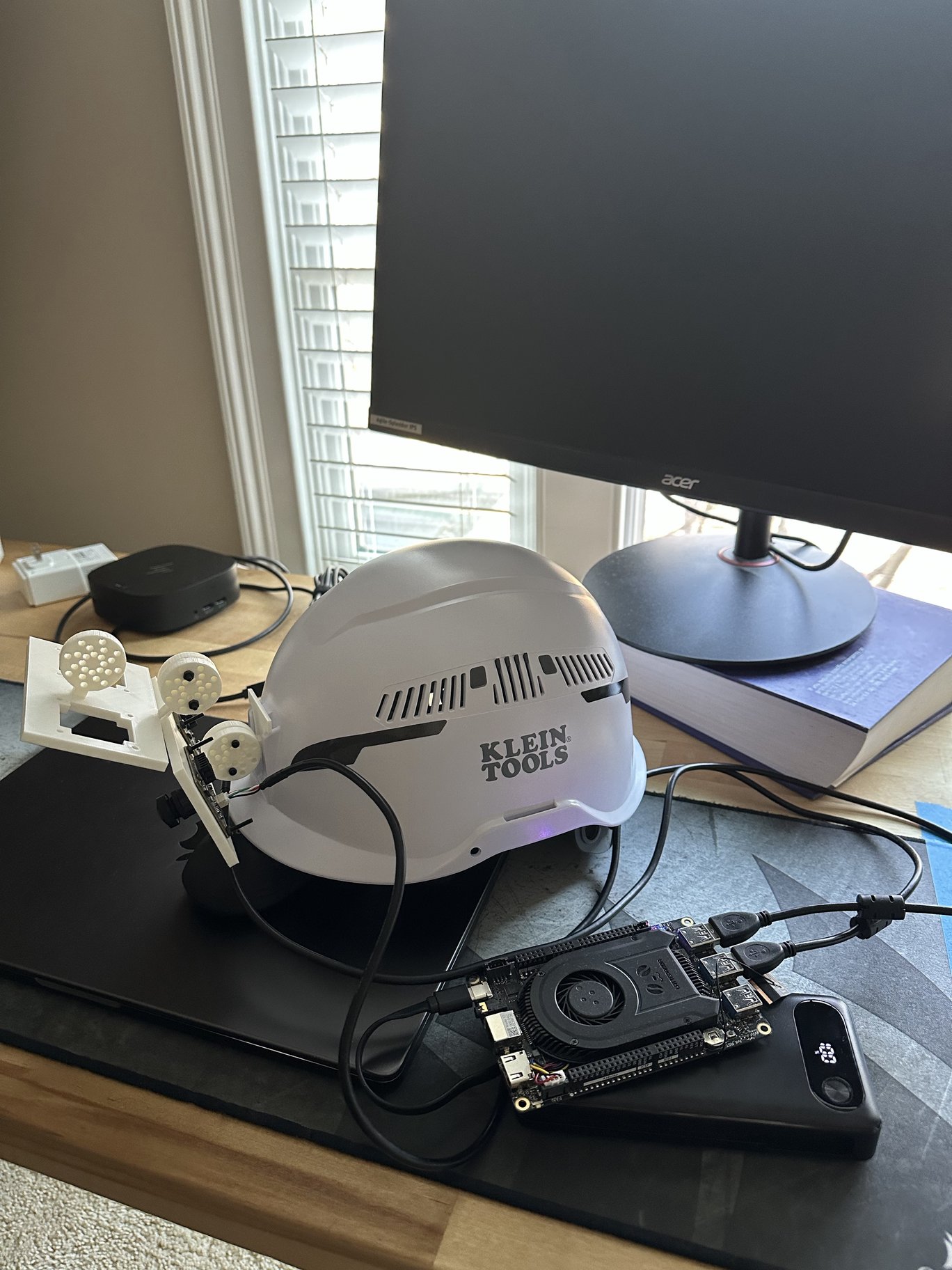
The original inspiration for this came from thinking about what the frontier of robotics data collection might look like. In the limit, nearly all economically valuable work needs to be automated. A substantial portion of the global economy is directed in real estate. Although only a subset of that is new construction and repairs, it still seems nonetheless like a very valuable area to target, especially considering housing shortages in America and around the world.
After a lot of tinkering around and searching for different parts on Google and scrolling through Arducam and Adafruit, in doing research on what good robotics data would look like, I went through a few different phases of construction and eventually settled on the idea of having a combination of cameras with varying widths for the field of view, ranging from 76 degrees to 160 degrees (FIT0729 sensors with 76 degrees and IMX291 sensors with 100 degrees and 160 degrees). We were initially considering Raspberry Pi cameras, but the ribbon cables would have likely been too sensitive for construction environments. The setup would have been limited to using Raspberry Pis, which seemed limiting in the event that it couldn’t handle the recording computationally.
To start, it would be preferred to make the setup not impede or impact the workflow of a given construction worker. I started with a helmet that they would likely be wearing on the job regardless. I ordered a construction helmet (Klein Tools 60565 Safety Helmet) with a camera mount, which would allow for 3D printing a custom mount for the cameras.
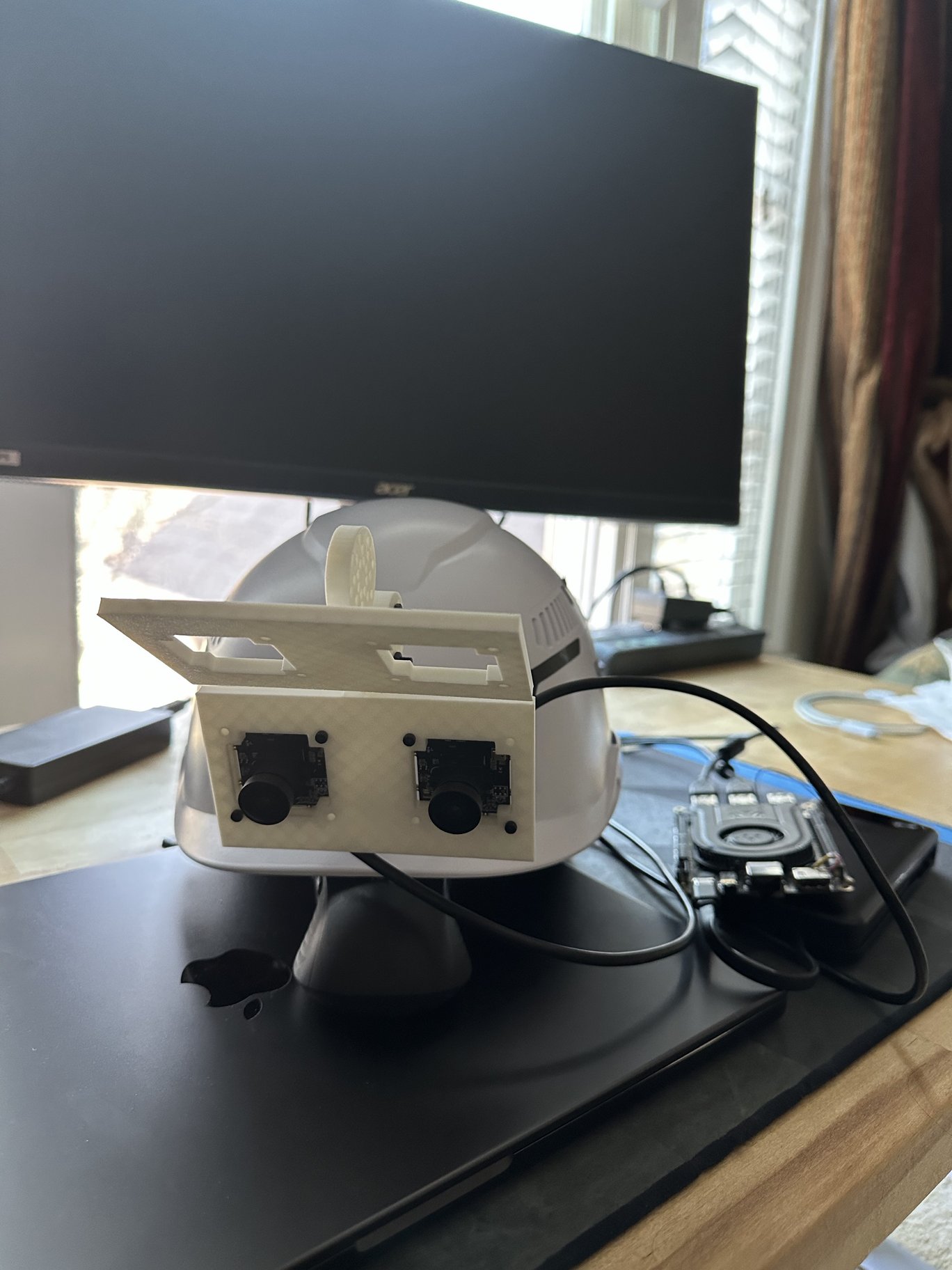
This went through a few iterations where, initially, the camera mount was at a fixed angle. There were two findings of note:
- One would want to change the angle of the camera depending on the specific use case and the width of the field of view of the camera.
- One may want to mount even more cameras and have those collecting data from different angles. For example, they may want some combination of stereoscopic footage for ultra-wide field-of-view cameras and standard field-of-view cameras.
It took a few iterations to get our custom mount to be flush with the slot in the helmet due to the unique nature of the wedge. It also took a few iterations to get the mount to be stable, given the unique tapering profile of it.
As you can see in the side view, there are a number of holes on the inter-mount mechanism that are spanning out radially, and are somewhat offset from each other.
This was designed to allow users to select different angles in increments of 15°. This would allow for, presumably, more precise control over the area that one was intending to capture for a given use case.
For example, one could imagine that plumbers and electricians may have different needs or requirements than a carpenter or someone who is laying cement.
It required something that was computationally capable and portable in order to collect the data.
I initially tried collecting data with the Raspberry Pi, but due to bandwidth limitations on the USB bus and computational limitations for the device itself, it could not maintain recording on multiple USB ports, especially when trying to capture uncompressed video footage.
I was led to believe that uncompressed video footage would be ideal, given that public datasets for robotics tended to be uncompressed images from what we saw online.
That may not have been necessary in hindsight, but nonetheless used a LattePanda courtesy of it also having relatively low power requirements.
The setup used a portable Anker battery pack off of Amazon because it would provide up to 70 watts of power, which should be sufficient to power the LattePanda for a few hours of continuous use.
After having the hardware set up in place and being able to start recording, we went through several iterations of trying to get the video footage to record consistently. We found that when attempting to record uncompressed video footage, it was difficult to maintain 30 frames per second. Frames would often skip, and we had trouble maintaining 30 frames per second of uncompressed footage for two cameras. We imagined that the barrier would be even larger with four cameras.
In addition, one could imagine that the form factor was likely not going to be conducive towards your average construction worker being able to use this out-of-the-box. In particular, how we would mount the LattePanda presented some challenges, especially considering how hot the device could be during recording.
I decided to put the project on pause in order to focus on what was then my main project.